
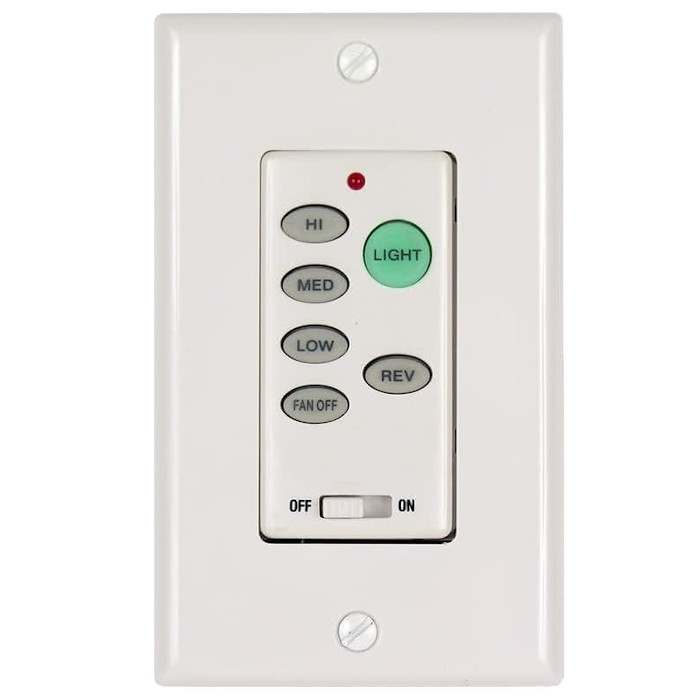
A handheld remote and a wireless wall control both send a radio signal to a receiver in the fan's canopy. A hard-wired slide or rotary wall control regulates the motor directly and needs no receiver. You can usually run a remote and a wireless wall control together, but never put a variable speed control or dimmer ahead of a remote receiver.
Ceiling fan wall control vs remote: what’s actually different?
Both do the same job, letting you change fan speed and work the light without reaching for a chain. The difference is where the control lives and how it talks to the fan. A handheld remote is a battery-powered transmitter you carry around the room. A wall control sits in the wall box where a light switch would normally go. It either talks to the fan by radio, or it sends power straight up the wires.
That second point is the one most people miss. “Wall control” covers two very different devices. Picking the wrong one is the most common reason a replacement doesn’t work.
Handheld remotes
A handheld remote sends a radio signal to a receiver, a small module hidden in the fan’s canopy or switch housing. The receiver does the real work: it switches the motor speeds and the light. Because the signal is radio rather than infrared, you don’t have to point the remote at the fan. Most handhelds run on a single 12V A23 battery, a 9V, or a pair of AAAs, depending on the model. Many come with a wall cradle so they have a parking spot.
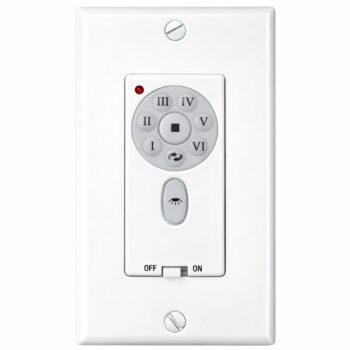
Wireless (RF) wall controls
These look like a fancy switch plate, but inside they’re basically a remote that lives on the wall. They also talk to a receiver in the canopy. Some are wired into the wall box and take their power from the house wiring. Others run on a battery and just mount over the box. The Hunter Fan guide to installing a ceiling fan remote sums up the relationship well: the wall control supplies power while the remote is what you’ll use day to day.
Hard-wired speed controls
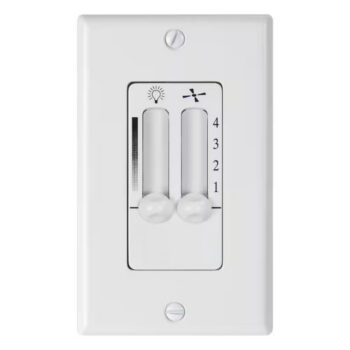
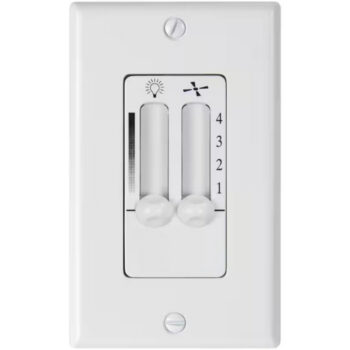
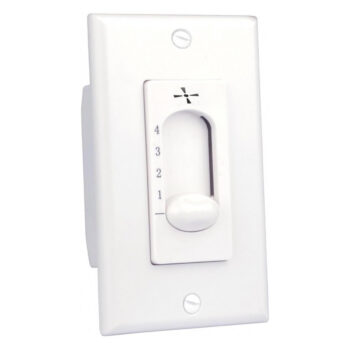
This is the older style: a slide or rotary control that regulates the fan motor directly through the house wiring. There’s no radio and no receiver. Dual-slide versions run the fan with one slider and dim the light with the other. They need separate fan and light conductors running from the wall box to the ceiling.
Which ceiling fan controls need a receiver?
| Control type | Needs a receiver in the fan? | Power source | Typical install |
|---|---|---|---|
| Handheld remote | Yes | Battery | No wiring; set code or pair |
| Wireless wall control, wired in | Yes | House wiring (some also hold a battery) | Replaces the wall switch, then set code or pair |
| Wireless wall control, battery only | Yes | Battery | Mount on the wall, set code |
| Hard-wired slide or rotary control | No | House wiring | Replaces the wall switch; fan chain set to high |
Quick way to tell what you have: if your fan’s canopy has a receiver with a code-switch bank or a pairing routine, it’s a radio system. Any handheld or RF wall control has to be set up to talk to that receiver. If there’s no receiver and the speed changes as you slide a knob on the wall, you have a hard-wired control. Its replacement should be another hard-wired control.
How do wireless wall controls pair with the receiver?
Pairing works the same two ways as handheld remotes do. Which one applies depends on the receiver already in your fan.
Code switches
Many wall controls for Hampton Bay, Harbor Breeze and Fanimation fans use a bank of four tiny DIP switches. You set the wall control’s switches to exactly the same up/down pattern as the switches on the receiver, and that’s it: no programming. Examples we stock include the UC9051T wall control and the C23 fan wall control, both wired into the wall box. There’s also the battery-powered CHQ8BT9051T wall control. Our guide to DIP switch settings walks through reading and copying a pattern.
SET button and power-up window
Other wall controls pair with a timed button press right after power comes back on. The TW30WH fan wall control for Fanimation, for example, has code switches plus a SET button. It keeps a small battery under the faceplate and needs a neutral wire in the box. After you press SET, the fan runs a short setup cycle before it’s ready. Timing details vary by model, so follow the instructions with your control or see how to pair a ceiling fan remote.
Why do some ceiling fans come with a wall control instead of a remote?
Many fans leave the factory with a wall control rather than a handheld, which is why our wall control listings cover brands such as Fanimation, Minka-Aire, Hunter and Progress Lighting. The appeal is practical. A control on the wall can’t slide under a couch cushion, guests find it where they expect a switch, and it never needs hunting down. Fans in great rooms, kitchens and rentals often get a wall unit for exactly that reason.
Hard-wired models such as the UC9031 dual-slide wall control, the 27182 wall control for Hunter fans and the fan-only WC115 wall control for Minka-Aire are a good fit when a fan has no receiver at all. They’re also simple: nothing to pair, nothing to lose. Their trade-off is that they need the right wiring in the wall. A dual-slide control needs separate fan and light wires to the ceiling, and the fan’s own pull chain has to sit on high so the control can reach every speed. You can browse every style in our ceiling fan wall controls category.
Can I use a wall control and a remote on the same fan?
Often yes, with an important rule about which kind of wall control.
Handheld + wireless wall control: usually fine
Two radio transmitters can share one receiver on many systems. On code-switch setups, set the remote and the wall control to the same pattern as the receiver and both will run the fan. On learning-code systems, each transmitter may need its own pairing step, and not every receiver accepts more than one. Check the instructions for your receiver before you buy.
Remote receiver + hard-wired speed control or dimmer: avoid
A receiver expects steady, full power from an ordinary on/off switch. Feeding it through a variable speed control or dimmer is asking for trouble. The Hampton Bay remote and receiver installation manual says plainly not to use the product with any variable wall control, and to supply the receiver through a regular wall switch. If you’re adding a remote to a fan that is currently run by a slide control, the slide control normally gets swapped for a plain switch. Ask an electrician if your wiring isn’t straightforward.
The wall switch still matters
Even on remote-only fans, the switch on the wall usually feeds the receiver. Turn it off and the remote goes dead because the receiver loses power. That’s handy when a fan won’t respond, and it’s why a remote “stops working” after someone flips the switch. If your remote is acting up for that or other reasons, our remote troubleshooting guide covers the usual causes.
Remote or wall control: which should you buy?
- Replacing what came with the fan? Buy the same type. A lost handheld gets a handheld; a dead wall unit gets a wall unit with the same part number.
- Want both? Check that your receiver uses code switches or accepts a second transmitter, then add a wireless wall control alongside the remote.
- Fan has no receiver? Either fit a hard-wired control, or convert the fan with a remote and receiver kit. See how to add a remote to a ceiling fan.
- Receiver is the problem? A new wall control won’t help a failed receiver. Our receiver replacement guide explains how to tell.
Get the right control the first time
Every listing in our store is matched to the exact part number in its title, so match the number printed on your old remote or wall control character for character. If the label is worn off, our page on finding your remote model number shows where else to look. Or text a photo of the control to (816) 586-8457 and we’ll point you to the right listing. In-stock orders placed by 4 PM Central ship the same day, and every uninstalled item can be returned within 90 days with no restocking fee.
Shop the Parts in This Guide
Frequently Asked Questions
Do wireless wall controls need batteries?
Some do and some don't. Battery-only models mount over the wall box with no wiring, while wired-in models draw power from the house wiring, and a few also hold a small battery for the transmitter.
Can I replace a hard-wired fan speed control with a remote?
Yes, but you also need a receiver in the fan, usually from a remote and receiver kit. The variable wall control is normally replaced with a standard on/off switch, and an electrician can handle the wiring if you're unsure.
Will a new wall control fix a fan that stopped responding to its remote?
Only if the old remote was the problem. If the receiver in the canopy has failed, neither a new remote nor a new wireless wall control will make it respond.
Does a wall control work if the light switch is off?
If a separate on/off switch feeds the fan, it has to stay on. A wireless wall control can only talk to a receiver that has power.
Why does my fan's wall control only run the fan and not the light?
Some wall controls are fan-only, with no light function. Check the listing for your control's part number before buying a replacement if you need light control too.